Bioinformatics-assisted genomic interpretation

Transforming Genetic Data Into Meaningful Biological Insights
The rapid development of genomic technologies has significantly increased the amount of genetic information available to researchers. Modern sequencing platforms generate extensive datasets that require specialized computational methods for processing, analysis, and biological interpretation.
Bioinformatics-assisted genomic interpretation combines computational science, molecular biology, and statistical approaches to transform complex genetic data into meaningful biological information. By integrating sequence analysis, genomic annotation, comparative investigation, and data visualization, researchers can explore genetic structures and identify molecular patterns associated with biological processes.
This integrated approach supports scientific investigation across molecular genetics, biotechnology, microbiology, biomedical research, and pharmaceutical development.
Understanding the Foundations of Genomic Bioinformatics
Genomic bioinformatics involves the application of computational tools and analytical methods to investigate genetic information. It enables researchers to organize, process, compare, and interpret large volumes of DNA and RNA sequence data.
The process begins with the generation of molecular information through sequencing technologies. Raw sequencing data are subsequently evaluated, processed, and analyzed using specialized computational pipelines.
Several fundamental activities contribute to genomic interpretation:
Processing and quality assessment of sequencing data.
Identification and comparison of genetic sequences.
Genome assembly and structural characterization.
Detection of genetic variations.
Functional annotation of genomic regions.
Interpretation of biological patterns through computational analysis.
These activities provide a structured framework for examining genetic information and understanding its potential biological significance.

Genomic Data Processing and Quality Assessment
Reliable genomic interpretation begins with the evaluation of sequencing data quality. Raw sequencing files may contain technical errors, low-quality reads, adapter sequences, or other elements that can influence downstream analysis.
Quality control tools help researchers assess sequencing accuracy, identify potential technical limitations, and determine whether datasets are suitable for further investigation.
Common bioinformatics tools include:
FastQC: Evaluates sequencing quality through indicators such as base quality scores, GC content, sequence duplication, and adapter contamination.
fastp: Supports quality filtering, adapter trimming, and preprocessing of sequencing reads.
MultiQC: Combines quality-control reports from multiple analytical tools into a consolidated overview.
These preprocessing procedures contribute to more consistent datasets and improve the reliability of subsequent genomic analyses.
Sequence Alignment and Genome Mapping
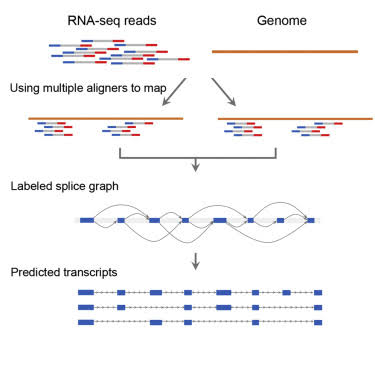
Sequence alignment is an essential component of genomic bioinformatics. It involves comparing nucleotide sequences to identify similarities, differences, and relationships between genetic regions.
Reference-based alignment allows sequencing reads to be mapped against an established reference genome. This process helps researchers determine the genomic origin of individual reads and identify potential variations.
Several specialized tools are commonly used:
BWA: Performs efficient alignment of sequencing reads against reference genomes.
Bowtie2: Supports fast and sensitive alignment of short DNA sequencing reads.
HISAT2: Provides alignment capabilities for RNA sequencing data, including splice-aware mapping.
STAR: Enables high-performance alignment of RNA sequencing reads across exon-exon junctions.
The resulting alignment files provide an important foundation for variant detection, transcriptomic investigation, and genomic characterization.
Genome Assembly and Structural Analysis
Genome assembly involves reconstructing longer genomic sequences from smaller sequencing fragments. This process is particularly important when studying organisms without a complete reference genome or investigating previously uncharacterized genetic material.
De novo assembly methods organize sequencing reads into longer contiguous sequences called contigs, which may subsequently be connected into larger scaffolds.
Genome assembly approaches can be supported by tools such as SPAdes, MEGAHIT, and Flye, depending on sequencing technology and research objectives.
Structural analysis also contributes to understanding genomic organization, including gene distribution, repetitive elements, and larger genetic regions.
Together, assembly and structural characterization provide valuable information for investigating genome architecture and biological diversity.

Genetic Variant Detection and Interpretation
Genetic variation represents differences in nucleotide sequences between individuals, populations, or biological samples. Bioinformatics methods help identify these differences and examine their potential biological relevance.
Variant detection pipelines may investigate:
Single-nucleotide variants.
Small insertions and deletions.
Copy number variations.
Structural genomic alterations.
Differences in genetic sequences between samples.
Tools such as GATK, FreeBayes, and bcftools support different stages of variant identification and analysis.
Following detection, variants can be annotated using genomic databases and specialized software. This process provides information about genomic location, potential functional consequences, and previously documented associations.
Interpretation requires careful consideration of sequencing quality, reference genome selection, biological context, and the limitations of available databases.
Functional Genomic Annotation
Genomic annotation aims to identify and describe the biological features present within genetic sequences. It helps researchers determine the location of genes, regulatory elements, coding regions, and other genomic components.
Functional annotation connects genetic information with biological knowledge by examining gene functions, molecular interactions, and associated biological pathways.
Several resources support this process:
Ensembl: Provides genomic information, gene annotations, and comparative genome resources.
NCBI: Offers extensive biological databases and sequence information.
UniProt: Provides detailed information about protein sequences and functions.
Gene Ontology: Organizes biological knowledge into molecular functions, cellular components, and biological processes.
KEGG: Supports the investigation of molecular pathways and biological networks.
These resources allow researchers to move beyond sequence identification and explore the possible biological significance of genomic findings.
RNA Sequencing and Gene Expression Analysis
RNA sequencing is widely used to investigate gene expression and transcript diversity. It provides information about RNA molecules present in biological samples under specific experimental conditions.
A typical RNA sequencing workflow includes RNA quality assessment, library preparation, sequencing, read alignment or quantification, and statistical analysis.
Computational tools such as HISAT2, STAR, featureCounts, Salmon, and DESeq2 support different stages of transcriptomic analysis.
Differential gene expression analysis can reveal changes in transcript abundance between experimental groups. These findings may help researchers investigate cellular responses, biological pathways, and molecular mechanisms.
The integration of transcriptomic data with genomic information provides a broader understanding of how genetic information is regulated and expressed.

Integrating Statistical Analysis and Data Visualization
Genomic datasets frequently contain thousands or millions of measurements. Statistical analysis is therefore essential for identifying meaningful patterns and distinguishing biological observations from technical variability.
Computational analysis may involve normalization, statistical testing, clustering, dimensionality reduction, and predictive modeling.
Data visualization tools help communicate complex results through graphical representations such as heatmaps, volcano plots, principal component analysis, genomic coverage plots, and phylogenetic trees.
Platforms and programming environments such as R, Python, Bioconductor, and specialized genomic visualization software support the exploration and presentation of genomic findings.
Combining statistical methods with clear visualization improves data interpretation and facilitates communication between computational researchers and experimental scientists.
Challenges in Genomic Data Interpretation
Despite significant technological advances, genomic bioinformatics involves several analytical and methodological challenges.
Large datasets require substantial computational resources, appropriate data management strategies, and carefully designed analytical pipelines. Differences in sequencing technologies, reference genomes, and processing parameters can also influence analytical outcomes.
Important considerations include:
Maintaining sequencing data quality and consistency.
Selecting suitable reference genomes and databases.
Controlling analytical bias and technical variability.
Ensuring reproducibility of computational workflows.
Interpreting genetic variations within their biological context.
Managing sensitive genomic information responsibly.
Documenting software versions and analytical parameters.
Addressing these challenges requires collaboration between molecular biologists, geneticists, bioinformaticians, and other scientific specialists.
Future Perspectives in Computational Genomics
The future of genomic interpretation is closely connected to advances in artificial intelligence, machine learning, long-read sequencing, and high-performance computing.
Emerging computational approaches are improving the ability to analyze complex genomic structures, investigate regulatory mechanisms, and integrate multiple types of biological data.
The combination of genomics, transcriptomics, proteomics, and metabolomics is also supporting more comprehensive investigations of biological systems.
As sequencing technologies continue to evolve, bioinformatics will remain essential for transforming large-scale genetic datasets into scientifically meaningful knowledge.